The Chant Beneath Chowringhee
THIS IS A WORK OF FICTION
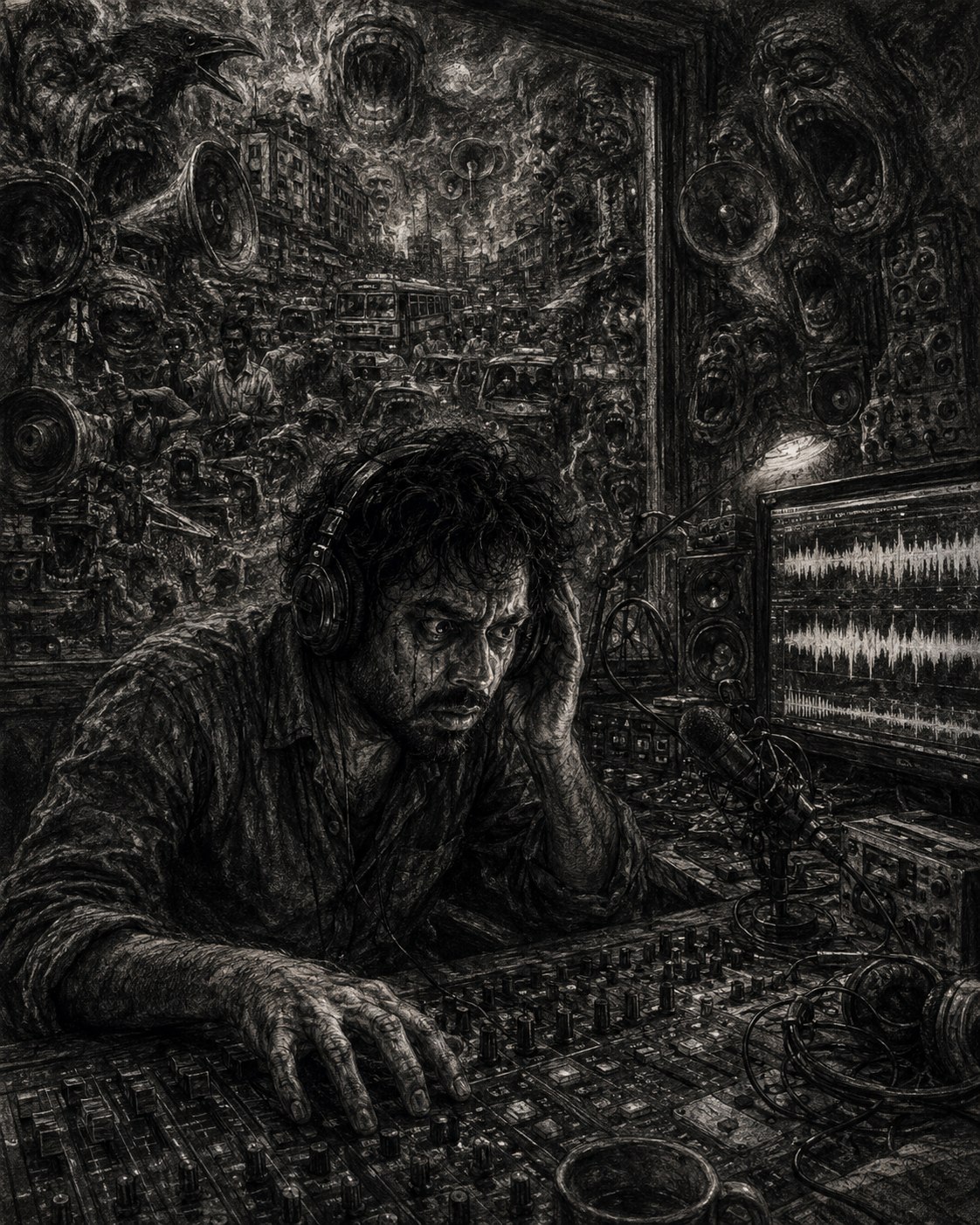
At quarter past nine on a Tuesday morning, when Calcutta had already begun boiling in its own tin kettle, Anirban Saha stood at the crossing near Esplanade with two microphones hidden inside a torn jhola and a look of such private disgust that three taxi drivers took it personally.
“Dada, going or recording our death certificate?” one shouted through the yellow Ambassador’s half-open window.
Anirban did not answer. He had learned that silence, properly maintained, irritated Calcutta more than any insult. Around him the city assembled its daily orchestra: buses coughing black phlegm, autos bleating, hawkers dragging their vowels over belts and socks and mobile covers, tram wires trembling faintly overhead like old nerves, crows conducting a court case from a rain-dark cornice, a generator behind a shuttered pharmacy hammering its own tin heart to pieces.
A tea seller in a vest slapped earthen cups onto his counter. “Sound people are mad people,” he told nobody in particular. “Film line. All ruined.”
“I am not in films,” Anirban said.
“Then fully ruined,” the tea seller replied, pleased with his diagnosis.
Anirban adjusted the gain on his recorder. He was forty-two, unmarried, underpaid, and recently dismissed from Eastern Wave Studios after refusing to make a minister’s nephew sound “more soulful” in a devotional album that had already committed several crimes against sound and possibly one against devotion. For twenty years he had cleaned other people’s voices, lifted hiss from cheap recordings, removed coughs from wedding speeches, made fools sound sincere and liars sound wounded. He knew the city by frequency. A bus horn had a boastful middle. A schoolgirl’s laugh peaked like glass. Rain on asbestos had no bass, only nervous treble. Rich men spoke from the throat; poor men from the chest; bureaucrats from the nose.
Now he had a room in a damp house off Surya Sen Street, six months’ rent unpaid, a mother in Uttarpara who believed he still had a respectable job, and an idea so petty that he felt ashamed of how much joy it gave him.
He would make a podcast.
Not one of those smiling, scented, over-explained things where educated people discovered poverty as if it had been hiding under the sofa. His would be called City Under Speech. Each episode would take the sound of one Calcutta crossing, one para, one market, and reveal what people had trained themselves not to hear. Horns like abuse. Political loudspeakers like fever. Construction drills like teeth. He would layer, isolate, amplify. He would make listeners flinch. He would weaponize attention.
Let them hear the city they had made.
The first recording from Esplanade sounded ordinary when he played it back that afternoon. Ordinary in the Calcutta sense, which meant intolerable but familiar, like a relative who borrowed money and then advised you on character. He sat at his desk below a patch of wall damp shaped like a kneeling man. His neighbor, Mrs. Dutta, had hung papads outside the shared balcony, where they absorbed more dust than sunlight. Downstairs, a child practiced multiplication tables with the grimness of a prisoner reciting charges.
Anirban listened again.
At first, there was only traffic.
Then, beneath 2.7 kilohertz, under the horns and calls and grinding engines, he noticed a rhythm. Not a beat exactly. A repetition. A low oscillation that seemed to gather separate sounds into one intention. The taxi horn, crow call, generator knock, bus brake squeal, hawker’s “cholbe cholbe,” all touched the same contour and withdrew.
He isolated the band.
The room changed.
Not visibly. The fan continued chopping the heat into large useless slices. A cockroach continued exploring the cracked switchboard with admirable professional confidence. But the air became attentive.
From the speakers came a murmur too low to be speech and too shaped to be noise.
Anirban leaned closer.
Maati dao.
He stopped playback.
The fan clicked.
From outside, Mrs. Dutta shouted, “Who is saying mati dao?”
“No one,” Anirban said too quickly.
“You said.”
“I did not.”
“Then your machine said. These machines learn bad habits from men.”
He shut the window.
Maati dao. Give earth.
It might have been pareidolia. The ear was a liar in a respectable coat. Give it static, it heard ghosts; give it silence, it heard accusation. He had built half his career correcting such nonsense. Still, he copied the file twice, labeled it ESPLANADE_RAW_01, and did not delete the filtered track.
That night he dreamed of his father digging in the courtyard of their old house in Behala, though they had never had a courtyard and his father had died in a second-floor room with peeling blue paint. In the dream, Baba dug with a serving spoon. Each scoop produced not soil but coins, tram tickets, fish bones, election leaflets, school badges, and finally a small brown hearing aid.
“Not yours,” his father said without looking up. “You only mixed it louder.”
Anirban woke with his hand over his right ear.
The second recording he made in Gariahat during rain.
By noon the market was in full quarrel with itself. Umbrellas knocked like antlers. Sarees under plastic sheets glowed damply. A man selling imitation perfume announced that French romance was available for eighty rupees. Fish scales flashed in the gutter. The rainwater ran black around ankles, carrying coriander leaves, paan spit, a dead matchbox, and one pink slipper without its owner.
Anirban placed a boundary microphone beneath the edge of a shuttered shop. Beside him, a girl in a blue kurti was bargaining for a pressure cooker as if conducting a hostage negotiation.
“Two thousand? For this? It sounds hollow.”
“Madam, your heart also sounds hollow if I tap. Does that mean discount?”
Anirban almost smiled.
When he returned home and filtered the Gariahat track, the murmur came faster.
Maati dao. Gola dao. Naam dao.
Give earth. Give throat. Give name.
His hands became cold despite the heat.
He checked for contamination, phase artifacts, harmonic coincidence. He ran the track through three different filters, then through an old analog equalizer whose left channel had the temperament of a retired tram conductor. The phrase remained. Not always cleanly. Sometimes it broke into syllables. Sometimes it rode a crow’s call or the metallic cough of a bus door. But it was there.
He uploaded the first episode that night.
He told himself he was not exploiting anything. He had not invented the city’s noise; he had only framed it. Besides, the podcast had twelve listeners, one of whom was probably his own account. A man needed some dignity, and dignity, in modern Bengal, had become like good mustard oil: expensive, adulterated, and always being recommended by people who had inherited houses.
By morning, the episode had eight thousand plays.
By evening, sixty thousand.
By the next day, people were sending him recordings. “Dada, capture Shyambazar five-point.” “Please analyze New Alipore puja pandal generator.” “My mother-in-law snores in a rhythm, possible municipal haunting?” “Brother, expose illegal honking mafia.”
Eastern Wave Studios called. He did not pick up.
Mrs. Dutta knocked with a steel bowl of muri and suspicion. She was sixty-five, widow, retired schoolteacher, and the sort of woman who could turn a missing clothes peg into a constitutional inquiry.
“You are famous?” she asked.
“No.”
“Then why are people downstairs asking for Soundbabu?”
“Wrong address.”
“One had a camera.”
“Very wrong address.”
She looked past him at the equipment. “Your father also did sound?”
“No. Railways.”
“Hmm,” she said, which in Bengali society contains roughly the same information as a sealed government file. “Last night, after your broadcast, my late husband’s radio started playing. Without current.”
“That is impossible.”
“So was my marriage lasting thirty-eight years, but there we are.”
She placed the muri on his table and lowered her voice. “The radio said my name.”
Anirban felt irritation rise first, because fear often entered him dressed as anger. “You heard what you expected to hear.”
“I expected Hemanta Mukherjee. I got ‘Madhumita, come down.’ Very disappointing.”
He wanted to laugh. He did not.
That week he made three more episodes. Gariahat. Shyambazar. Park Circus. Each time the hidden chant altered slightly, as if the city were changing its mouth around a stubborn seed.
Maati dao. Gola dao. Naam dao. Ja keu shone, shey phirey dao.
Give earth. Give throat. Give name. Whoever hears, return them.
He edited the phrase under the published episodes, not clearly enough for everyone, but enough to make them lean in. Comments multiplied. People listened at night with earphones and wrote that they heard grandmothers, missing brothers, a child crying from a locked bathroom in 1987, a lover saying sorry after twenty years. One man claimed his ceiling fan whispered his board exam marks. Another said his dead dog barked from inside the refrigerator. The internet, Anirban discovered, was simply a para with no tea stall and worse manners.
Yet the fear was real.
He received a message from a woman named Raka Mitra, who worked as a location recordist for documentaries and knew enough to be dangerous.
This is not random. Call me before you upload more.
He ignored it.
She came anyway.
Raka arrived at dusk carrying a field recorder, two microphones, and the air of a person who had already decided he was guilty but might be useful. She was short, sharp-eyed, with rain-frizzed hair and a scar across her chin. She looked around his room, at the foam panels curling off the wall, the unpaid electricity notice, the damp stain.
“You are boosting it,” she said.
“Tea?”
“You are boosting it.”
“That is how audio works.”
“That is how fraud works also. Similar tools.”
He liked her immediately and resented this.
She played him a file from 1996. Cassette hiss. Durga Puja crowd near College Street. Dhak, conch, loudspeaker, traffic.
Under it: the same low contour.
“No podcast then,” she said. “No viral nonsense. My father recorded this. He studied urban noise for All India Radio before everyone decided culture meant panel discussions and sponsorship banners.”
Anirban listened, his mouth dry.
The chant was fainter, but unmistakable.
Maati dao.
Raka watched him. “My father became obsessed. He said Calcutta had a carrier frequency. Not metaphorically. A city-sized acoustic standing wave shaped by traffic corridors, tram lines, old drainage tunnels, hawker calls, temple bells, generators, crows, everything. He thought language had grown on it like fungus.”
“What happened to him?”
“He walked into the Maidan one evening with a spade and did not come back for two days. When police found him, he was digging beside an old tram rail near Kidderpore. He had no memory. After that he never recorded anything again.”
Anirban replayed the file.
“Why tell me?”
“Because your edits are making it clearer. People are hearing private things because you are giving the chant a throat.”
He almost said good. Let them hear. Let everyone suffer accuracy for once.
Instead he said, “That’s superstition with equipment.”
Raka smiled without pleasure. “The favorite Bengali combination.”
A power cut dropped the room into darkness. The fan died mid-click. Outside, the whole lane groaned and then rearranged itself around the absence of electricity. Someone cursed CESC. Someone else cursed the government. A generator coughed alive downstairs.
From Anirban’s speakers, unplugged, came his father’s voice.
Ani.
Not loud. Not dramatic. Almost bored, as Baba had sounded when calling him to fix a fuse, lift a suitcase, stop wasting money on headphones.
Ani, tui shunchish?
Are you listening?
Anirban struck the speaker off the table. It hit the floor, split, and went silent.
Raka did not move.
“My father never called me Ani,” he said.
“Liar,” she replied softly.
He sat down because his knees had become theoretical.
His private wound was not ornate. There had been no great betrayal, no cinematic last words. Only a hospital corridor in 2014, a dying father, and Anirban arriving late because he had been mixing a commercial jingle for a fairness cream and had silenced his phone to avoid “disturbance.” His mother had said, “He asked once.” That was all. He asked once. For twelve years those three words had lived in Anirban’s ribs like a fish bone.
Now the city had found the bone and tapped it with a spoon.
“We have to record where it is strongest,” he said.
Raka stared. “That is your conclusion?”
“If we identify the source, we can stop the resonance.”
“Or you can produce the grand finale and become the saint of acoustic stupidity.”
He stood. “You came because you wanted to know too.”
Her silence admitted more than agreement.
They went after midnight, when Calcutta’s noise thinned but did not sleep. The city at that hour was not quiet; it merely changed instruments. Dogs took over from buses. Distant trains dragged iron across the dark. Tea stalls became confession boxes for drivers, guards, men between shifts, men avoiding home. Sodium lamps turned puddles into jaundiced mirrors. Political posters peeled from walls in tired layers, each leader smiling over the previous leader’s torn forehead.
Raka’s father’s notes had marked a point near the old tram depot at Kidderpore, where disused rails ran under newer asphalt and the Hooghly breathed its muddy smell through lanes of warehouses, cheap eateries, and locked gates. They carried recorders, a coil of cable, and a small speaker Anirban had repaired with tape.
“Why here?” he asked.
“Old drainage channels. Tram vibration. River. Port machinery. All the city’s bones touching.”
A watchman in a monkey cap challenged them, then accepted two hundred rupees and the explanation that they were from a college. In Calcutta, “college” still opened doors that “work” did not, because education remained the last respectable mask for having no money.
They set the microphones beside a rusted tram rail visible through broken asphalt. The street smelled of diesel, wet rope, stale fish, and the sweet rot of the river. Somewhere a generator labored. A crow called once though it was night.
The waveform rose on Anirban’s recorder.
This time the chant did not hide.
Maati dao. Gola dao. Naam dao. Ja keu shone, shey phirey dao.
Then another line.
Jara chapa porechhe, tader tule dao.
Raise those who were buried.
Raka whispered, “Buried where?”
The ground answered.
Not with an earthquake. Nothing so generous. The tram rail trembled lightly, as if something below had plucked it. Then from under the asphalt came a tapping.
Once.
Twice.
A patient sound.
Anirban remembered, absurdly, the hearing aid from his dream. He remembered the damp stain on his wall shaped like a kneeling man. He remembered every time he had removed breath from a recording because breath was “noise.” Every intake before speech, every tremor, every poor singer’s crack, every old person’s wet cough. He had spent his life cleaning away evidence that bodies were struggling.
Raka crouched, face pale. “Pack up.”
But Anirban had already connected the small speaker. He needed to play the filtered chant back into the rail, invert the phase, cancel it. A childish solution, perhaps, but sound obeyed laws even when people did not.
“What are you doing?”
“Stopping it.”
“You don’t know what it is.”
“I know what amplification does.”
He pressed play.
The chant poured from the speaker into the metal rail. Low, shaped, intimate. For one second, the city seemed to hold its breath.
Then every horn in Calcutta sounded.
Not nearby. Everywhere.
From Esplanade to Gariahat, Shyambazar to Park Circus, buses, taxis, autos, private cars, ferry horns, train whistles, pressure cookers, temple bells, school bells, bicycle bells, crows, dogs, generators, the metal shutters of shops, the throats of sleeping men, all rose into one enormous chord. It passed through Anirban’s chest and opened something there without touching skin.
The asphalt cracked along the old tramline.
From below came voices.
Thousands. Not ghosts as stories made them, not pale figures seeking revenge, but trapped utterances, crushed and stored. Last breaths under collapsed houses. Names shouted during riots and floods. Workers sealed in construction pits. Infants buried without certificates. Women whose families said fever when they meant fire. Men who vanished into police vans, debt, river mud, unpaid wages, embarrassment. The city had not remembered them kindly. It had remembered them mechanically, as vibration. Calcutta, talkative old fraud, had kept every silenced throat in its infrastructure.
And Anirban’s podcast had taught the living to hear them.
Raka grabbed his arm. “Anirban!”
But through the roar he heard Baba again.
Ani.
This time not from the speaker. From the rail.
He understood then. His father was not buried under Kidderpore. He was not trapped in asphalt. The chant had used Baba’s voice because guilt was the microphone Anirban kept polished. It spoke in whatever tone made a listener lean closer. It did not want his father.
It wanted a name.
A name gave shape. A throat gave passage. Earth gave exit.
The cracked road widened. Under the rail, something pale moved, not a hand, not yet a hand. A pressure of almost-people.
Raka pulled him backward. “Leave the recorder!”
But the recorder was running. It had his voice. His breath. His file names. His published feed. His little revenge on a noisy city. Already, he could imagine tomorrow’s listeners pressing earphones deeper, hungry for the next episode, loneliness making them brave and foolish. The chant would ride him outward. Every living room, bus seat, hostel bed, office cubicle. A city did not need lungs if it had listeners.
He dropped to his knees and reached for the recorder.
The rail burned cold. The tapping below became frantic. Raka swore and tried to drag him away. He tore the memory card out, put it between his teeth, and bit until plastic cracked and copper cut his tongue.
The chord faltered.
The crack in the asphalt held open.
Not closing. Waiting.
The small speaker continued playing the chant from its internal buffer.
Maati dao. Gola dao. Naam dao.
Anirban looked at Raka. Her face was wet with rain or tears or river mist. He wanted to tell her to run, but his mouth was full of blood and broken memory card.
So he did the only clean thing left to him.
He lifted the speaker and pressed it against his own throat.
Sound entered bone differently. He had known that professionally. He had not known it personally. The chant struck his larynx and found meat. His body tried to form the words. He clamped his jaw shut. His teeth cracked harder. Blood ran down his neck. The city roared in protest, then narrowed, all that vast hunger forced through one resisting human passage.
Raka understood. She unplugged the cable from the rail and wrapped it around the speaker, killing the feedback loop. The sudden silence was so complete that the river sounded embarrassed.
The asphalt crack sealed with a wet sigh.
Anirban fell sideways.
He woke near dawn on a bench outside a tea stall, wrapped in Raka’s dupatta and unable to speak. His throat felt packed with gravel. Raka sat beside him, holding the ruined recorder. Her left palm was burned in a line where the cable had bitten.
“You owe me a dupatta,” she said.
He tried to answer. Only a rasp came.
“Good,” she said. “For some men, improvement.”
Across the street, Kidderpore was resuming itself. A handcart rolled past. A boy washed glasses in gray water. Two drivers argued over who had blocked whom in a lane large enough, theoretically, for one bicycle and three opinions. The city looked ordinary again, which was its most successful disguise.
Later, Raka deleted the podcast episodes. Some copies remained, of course. Copies always remained. But without Anirban’s filtered tracks and feed, they became muddy curiosities, urban legend, forwarded warnings. People moved on. There were elections, floods, celebrity scandals, bridge repairs, onion prices. Calcutta had a great gift for surviving revelation by putting it in the same mental drawer as a leaking tap.
Anirban moved to Uttarpara with his mother and took small jobs restoring old family recordings. Wedding cassettes. Radio interviews. A dead grandfather singing badly but sincerely. He stopped removing breaths unless asked twice. Sometimes he left in the chair creak before a confession, the cough before a blessing, the silence after a name.
He never recovered his voice fully. It came out rough, as if each word had to cross a damaged bridge. His mother said it made him sound wise. Raka said it made him sound like a bus conductor with metaphysical problems.
Once a month, she visited with new recordings they did not analyze too deeply. They listened only enough to know whether the chant was growing.
It was not gone.
It had retreated beneath the daily racket, patient as damp behind paint.
One evening in late September, during a power cut, Anirban sat by the open window while his mother slept inside. Rain tapped the balcony grill. A generator started somewhere far down the lane. A crow shifted in the dark. From a passing auto came a horn, brief and irritated.
Three notes.
Anirban froze.
The horn called again.
Not maati dao this time.
Not give earth.
In the cracked, practical, almost comic voice of the city, it said something older and worse.
Shunechho. Ebar bolo.
You have heard. Now speak.